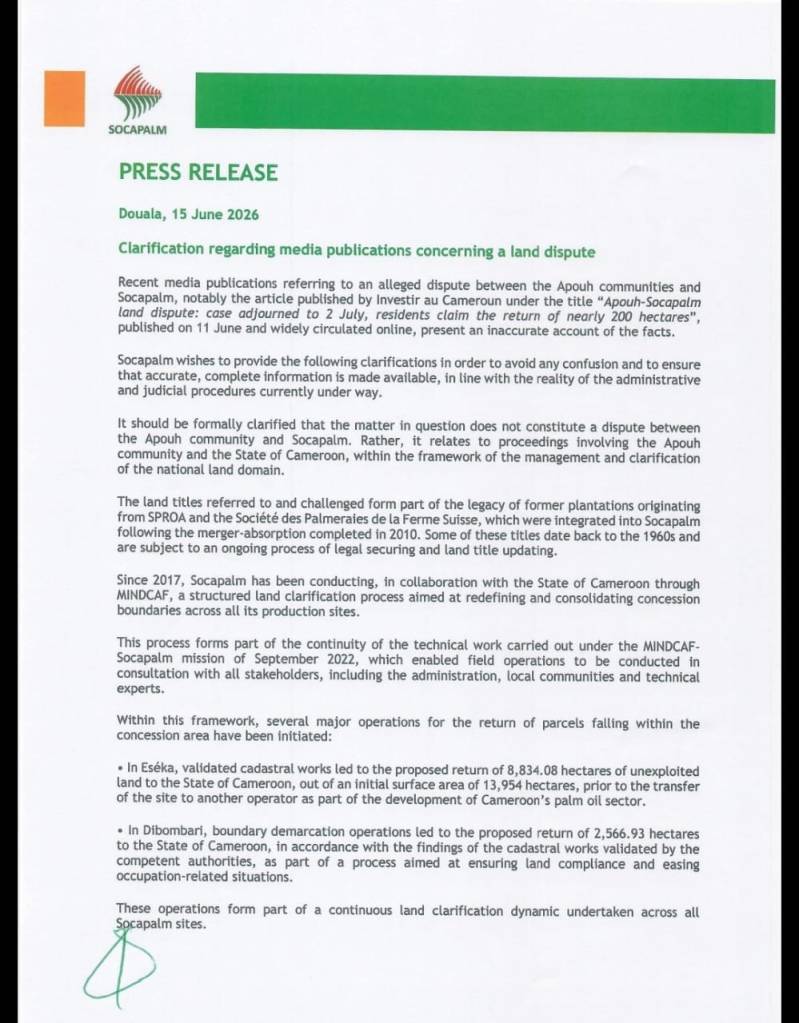
In a country where land remains both an economic asset and a deeply sensitive social question, the Apouh file deserves more than slogans. It requires legal precision, institutional clarity and journalistic responsibility. What is often presented as a direct court battle between the Apouh community and Socapalm is, in substance, an administrative matter involving the State of Cameroon and the clarification of land boundaries covered by long-standing land titles.“ A land dispute is not resolved by noise, but by evidence, procedure and responsibility. ”The controversy surrounding the so-called “ Apouh-Socapalm affair ” has become a revealing test case for Cameroon’s land governance. At first glance, it appears to be another local dispute between a rural community and a major agro-industrial operator. But that reading is incomplete. Worse, it risks misleading public opinion.At the centre of the matter lies a fundamental legal distinction: the case referred to before the administrative jurisdiction is not, according to our available information, a direct lawsuit brought by the Apouh community against Socapalm. It concerns the Apouh community at Ngog and the State of Cameroon, in connection with the review and clarification of land areas included in titles associated with Socapalm’s operating perimeter.That distinction is not a technicality. It is the core of the matter.Socapalm’s public clarification of 15 June 2026 stated that the case “ does not constitute a dispute between the Apouh community and Socapalm ”, but falls within a broader administrative process concerning national land management and clarification. This position was reported by several Cameroonian media outlets following the company’s statement.The legal logic is clear. In Cameroon, administrative courts are competent where acts, decisions or omissions attributable to public authorities are challenged. Law No. 2006/022 of 29 December 2006, published by the Supreme Court of Cameroon, lays down the organisation and functioning of administrative courts. In land matters, this matters greatly: titles, ministerial decisions, cadastral operations and boundary-related administrative acts are issued or supervised by the State.This is why the State cannot be edited out of the story.As counsel for the applicants reportedly explained, the action was directed primarily towards the State because “land titles, ministerial orders and administrative acts ” are taken by the State of Cameroon. That sentence should have ended much of the confusion. Instead, part of the public debate has turned an administrative clarification procedure into a symbolic prosecution of a private company.The risk of a convenient but inaccurate narrativeThere is a powerful temptation in land debates to reduce complexity to a simple moral confrontation: communities on one side, company on the other. The image is compelling. It travels well. It is easy to reproduce in headlines and social media clips. But it is not always legally accurate.In the Apouh case, the contested issue concerns land titles reportedly numbered 183 SN, 184 SN, 195 SN, 196 SN and 197 SN, issued on 10 August 1960 to the Société camerounaise de palmeraies. These titles belong to a historical agro-industrial chain involving former plantations from SPROA and the Société des Palmeraies de la Ferme Suisse, later integrated into Socapalm through the 2010 merger-absorption process, according to Socapalm’s clarification relayed in the press.This historical background does not automatically settle every boundary question. But it does establish one essential point: Socapalm is not operating in an illegal vacuum. Its presence is attached to titled land, inherited rights, administrative records and a national framework for land governance.Where disputes arise over boundaries, surface areas, alleged overlaps or the updating of old cadastral references, the answer cannot be media simplification. It must be technical verification, contradictory boundary reconstruction, administrative review and, where necessary, judicial arbitration. “A court may settle a dispute. A headline cannot redraw a cadastre.”A company that chose clarification over silenceOne fact deserves greater international attention: Socapalm did not wait for the current controversy to begin a land clarification process.Since 2017, the company has stated that it has been working with the Cameroonian State, through the Ministry of State Property, Surveys and Land Tenure, on a structured programme to redefine, verify and densify the boundaries of its concessions across its production sites. This process involves public administration, technical experts and neighbouring communities.The results cited by the company are significant.At Eséka, cadastral work reportedly led to a proposed restitution of 8,834.08 hectares of unexploited land to the State of Cameroon, from an initial surface area of 13,954 hectares. At Dibombari, boundary operations reportedly resulted in a proposed restitution of 2,566.93 hectares. Together, these two sites represent more than 11,400 hectares proposed for return to the national domain.That is not the posture of an operator refusing scrutiny. It is the posture of a company accepting that historical concessions must be reassessed under modern expectations of traceability, legal certainty and community dialogue.The same process is continuing at Mbongo, Mbambou, Kienké and Édéa. On the Édéa site, where the Apouh issue has attracted public attention, Socapalm says boundary reconstruction operations are being carried out in a contradictory framework involving administrative authorities, technical experts and neighbouring communities.Land governance is not a theatre of accusationCameroon’s land law imposes procedure. It does not operate through insinuation.Decree No. 2005/481 of 16 December 2005, amending Decree No. 76/165 of 27 April 1976 on land certificates, provides mechanisms for addressing irregularly issued land certificates, including action by the minister in charge of land tenure and possible proceedings before the competent administrative jurisdiction.That legal framework is important because it shows that land title disputes are not decided by public pressure alone. They require evidence. They require competent authorities. They require procedural discipline.This is precisely where the Apouh debate must be reframed. To speak of “land grabbing” without carefully distinguishing between existing titles, administrative acts, boundary reconstruction, community claims, technical findings and ongoing restitution processes is to flatten a complex issue into an accusation. Such flattening may be politically attractive, but it does not help the communities. It does not help the State. It does not help investors. It does not help the truth.For international observers, the case also raises a broader issue: how African agro-industrial concessions inherited from earlier periods can be responsibly updated without destroying productive assets, destabilising local economies or ignoring legitimate community concerns.The answer cannot be denial. Nor can it be agitation. It must be method. Socapalm’s position: Compliance, dialogue and restitution where justified The responsible way forward is neither corporate triumphalism nor activist absolutism. It is institutional problem-solving.Socapalm’s stated approach rests on four pillars: clarify the perimeter, reconstruct boundaries, densify physical markers and return areas where technical conclusions justify restitution. That is a pragmatic framework. It recognises that historical land files may require updating. It also recognises that economic operators need legal certainty to invest, produce and employ.This is why the company’s clarification process matters beyond the Apouh locality. It speaks to the future of agro-industrial governance in Cameroon. Investors need secure titles. Communities need transparent boundaries. The State must play its role as regulator, guarantor and arbitrator. The media must report with precision.When one of these roles collapses, confusion fills the gap.The Apouh case should not be used to manufacture hostility against an enterprise that has engaged in a documented process of clarification and restitution. Nor should the concerns of neighbouring communities be dismissed. The point is balance: grievances must be heard, but they must be addressed in the right forum, against the right institutional actors, with the right documents and under the right legal procedure.Responsible reporting is part of land peaceThe final lesson is journalistic.Land disputes are among the most sensitive public issues in Central Africa. They touch ancestry, livelihoods, administrative history, rural development, industrial production and national sovereignty. Reporting on them requires restraint. It requires the humility to distinguish allegation from proof, court procedure from public controversy, and administrative responsibility from corporate liability.In the Apouh matter, the public deserves to know that an administrative case is not automatically a direct lawsuit against Socapalm. It also deserves to know that Socapalm has been conducting a land clarification programme since 2017, with substantial proposed restitutions already recorded on other sites.The next phase at Édéa should therefore be watched carefully, but fairly.

The objective should not be to identify an easy culprit. It should be to bring a sensitive file out of the fog of competing narratives and into the discipline of cadastral truth, legal procedure and constructive dialogue.Socapalm has made one important choice: to engage with clarification rather than allow ambiguity to persist. In a country where land security remains central to development, that choice is not marginal.It is a method.And in matters of land, method is often the difference between conflict and settlement.


Leave a comment