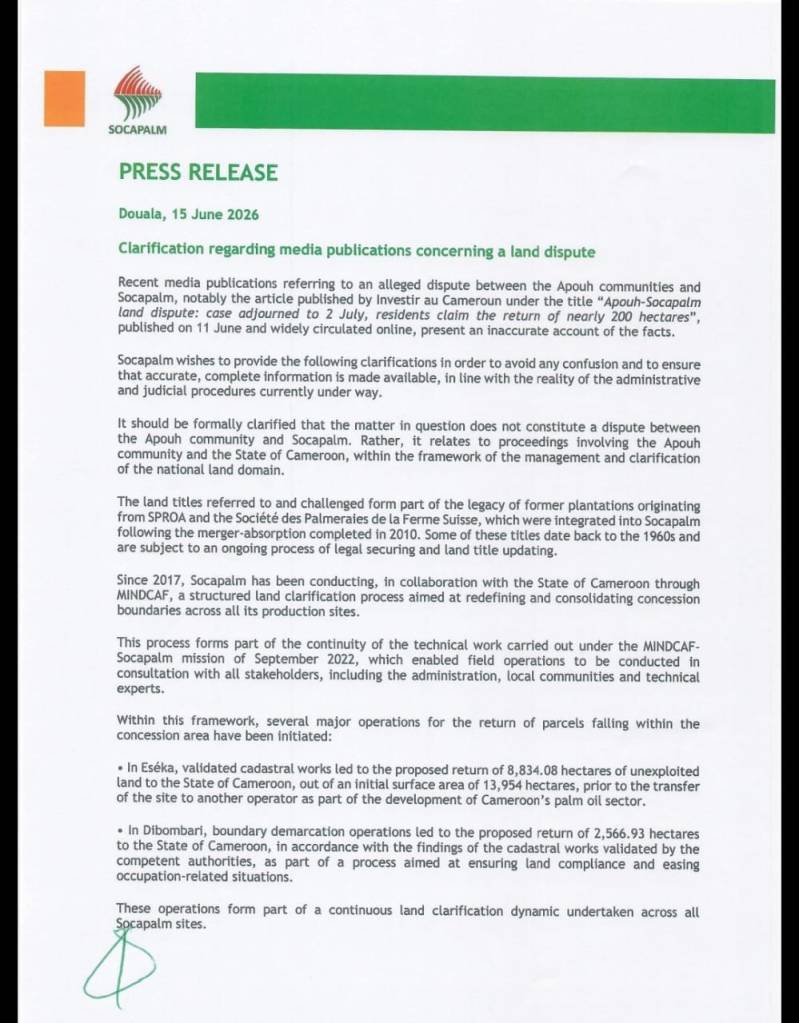
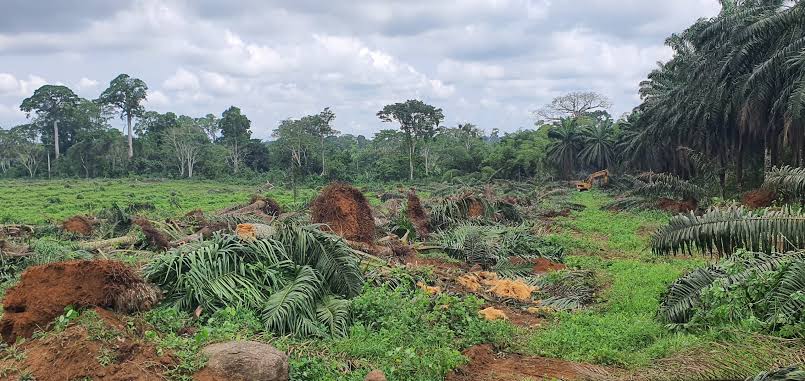
The land dispute involving the community of Apouh in Ngog (Édea I subdivision) and the broader state-managed. Agro-industrial framework has entered a new procedural phase, following the postponement of the first administrative court hearing initially scheduled for June 4, 2026. The session has been rescheduled to July 2, 2026, after technical disruptions at the courthouse.The upcoming hearing is expected to designate a rapporteur judge responsible for examining the merits of the case and presenting a structured analysis to the judicial panel an essential step in proceedings that underscore the complexity of balancing agro-industrial concessions with local land use and community rights. A dispute centered on historical land titles The case, initiated by the traditional leadership of Apouh in Ngog and supported by the Association of Women Living Near Socapalm Édéa (AFRISE), concerns five land titles issued on August 10, 1960 (183 SN, 184 SN, 195 SN, 196 SN, and 197 SN).According to the plaintiffs’ counsel, Jean-Marc Touon, the legal action is primarily directed against the State of Cameroon on grounds of alleged administrative overreach, rather than targeting the agro-industrial operator directly.“The action is not exclusively directed at Socapalm, because the land titles, ministerial decrees, and administrative instruments originate from the State of Cameroon,” Touon stated.The community does not seek the cancellation of the historical titles themselves but requests judicial recognition of alleged encroachments and the restitution of approximately 200 hectares of ancestral land.Tensions have reportedly increased since 2023, particularly in connection with replanting operations said to have affected local agricultural activities. Civil society concerns and land governance questionsA report by the civil society organization Green Development Advocates (GDA) also raised questions regarding the legal status of an adjacent 874-hectare area allocated through a 2021 prefectural decree, suggesting that agricultural operations may have begun prior to the completion of formal concession procedures.These elements have contributed to broader discussions on land governance, transparency, and the management of agro-industrial concessions in Cameroon. Socapalm’s clarification and boundary regularization processIn response to public commentary and media coverage, Socapalm issued a detailed clarification aimed at correcting what it describes as misinterpretations of the legal and operational context.The company emphasizes that the matter should not be construed as a direct dispute between itself and the community, but rather as a legal proceeding involving the State of Cameroon and local stakeholders concerning the management of national public land.Socapalm further explains that the contested titles originate from former plantations (SPROA and Société des Palmeraies de la Ferme Suisse), later integrated into its operations following the 2010 merger. These historical land assets are currently undergoing formal legal and cadastral updating.
A joint field verification involving relevant stakeholders has already been conducted, and the company indicates that the operational phase of boundary reconstitution for the Édéa site is scheduled to commence on June 16, 2026. Ongoing cooperation with public authorities Socapalm also highlights its continued collaboration with the Ministry of State Property, Surveys and Land Tenure Affairs (MINDCAF) since 2017, aimed at auditing and consolidating land boundaries across its operational sites.According to the company, this structured and consultative approach has already led to the return of significant land areas to the State, including:Éséka: 13,954 ha initially identified, with 8,834.08 ha of unexploited land returned prior to site transfer to a new operatorDibombari: 2,566.93 ha adjusted following validated cadastral review and conflict mitigation measuresÉdéa (Apouh): Under review, with approximately 200 ha currently contested and subject to ongoing boundary reconstitution beginning June 16, 2026 Ownership structure and governance commitment Socapalm is majority-owned by the Cameroonian Palm Grove Company (Socfinaf) at 67.46%, with 22.36% held by the State of Cameroon, and the remainder publicly traded on the Douala Stock Exchange.The company reiterates its commitment to transparency, regulatory compliance, and constructive engagement with local communities. It also calls for caution in public communications and encourages reliance on verified administrative and legal sources. A case with broader implications As the July 2 hearing approaches, the Apouh case is increasingly viewed as a reference point in the ongoing debate over agro-industrial land concessions in Cameroon highlighting the intersection of historical land allocations, state regulatory frameworks, and the livelihoods of local populations.
 Visionary Reports
Leave a comment