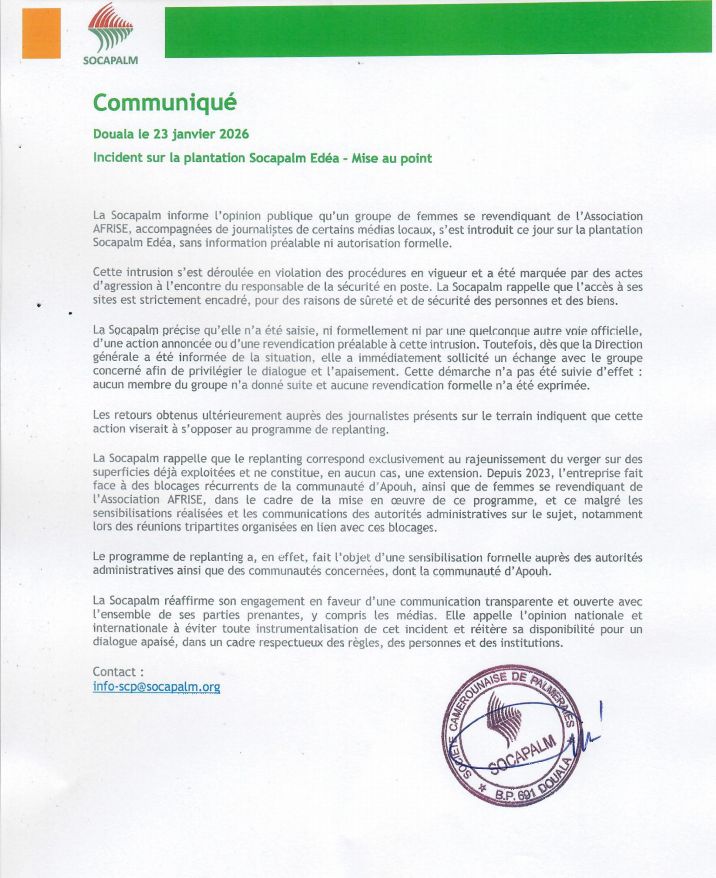
Socapalm, Cameroon’s leading palm oil producer, has issued a formal denunciation following what it describes as an “unauthorized and aggressive” intrusion at its Edea plantation on Friday, January 23, 2026.
Early Friday morning, a group of individuals entered the plantation site carrying placards demanding the return of “ancestral lands.” According to company reports, protesters bypassed security protocols and allegedly committed acts of aggression against security personnel on duty.
Socapalm’s Communication Department, led by Barbara Lienoue, immediately engaged with local traditional leadership. While the village ruler denied prior knowledge of the protest, he urged the company to pursue a “frank and sincere dialogue” with the community a proposal Socapalm management says it has officially accepted.
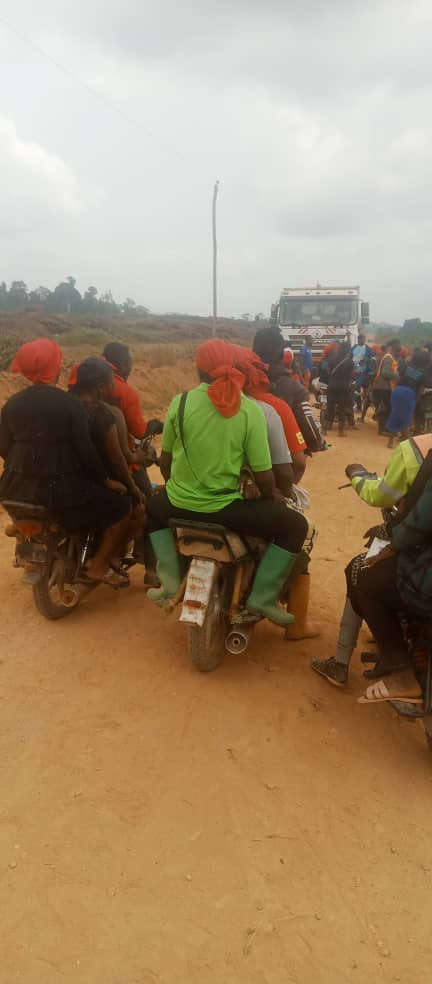
Jules Germaine Kamta, Secretary General of Socapalm, spoke out strongly against the actions of the group, specifically identifying the association AFRISE and the Apouh women. “Socapalm Edea is a private business. When someone enters a private property, the minimum requirement is to inform the owner or seek authorization,” Kamta stated. “This was not the case here. Even the administrative authorities confirmed they granted no such authorization.”
Kamta suggested the intrusion was a calculated attempt to bait the company into a physical confrontation. “The goal is to show the world a vision of Socapalm assaulting women. This is pure provocation. Beyond the violation of private property, it is an attempt to exploit public opinion.”
Furthermore,the tension appears rooted in a dispute over “vital space” and land property rights. Kamta clarified that the Edea site operates under a formal state concession and that Socapalm remains the legal occupant of the land. He also raised questions regarding the legal standing of the AFRISE association, noting that previous inquiries to the Ministry of Territorial Administration failed to produce evidence of the group’s official registration.
The Secretary General noted that this is not an isolated incident:
Last year, during the dry season, the same group reportedly disrupted preliminary work by attempting to plant plantains within the Socapalm concession. Socapalm has filed formal complaints regarding these repeated intrusions and acts of violence.
Socapalm clarified that the current friction stems from a misunderstanding of their replanting program. The company emphasizes that “replanting” refers to the rejuvenation of aging trees on land already under cultivation not an expansion into new territory.
Management noted that this program has been the subject of awareness campaigns involving the Apouh community since 2023. Furthermore, the company revealed it is already in the process of voluntarily returning specific land parcels to the community, making the “impetuous” nature of Friday’s protest particularly unexpected.
Nevertheless,Socapalm expressed regret that the protesters ignored immediate attempts at de-escalation and failed to present any formal list of claims during the unauthorized event.
The company is now urging the Apouh community and the AFRISE association to allow the Ministry of State Property and Land Tenure to complete its official processes. Management maintains that following established legal channels is the only way to ensure a resolution that respects both the industrial sector and the rights of the local population.
 Visionary Reports
Leave a comment